At first, the lack of coverage of spring training pissed me off: even with cable (not that I have it) only a few games on television, even fewer on radio, and no Gameday play-by-play on mets.com. I think I like it, though. The lack of constant information feels like a connection to the old ballgame, and that’s always welcome: getting information in spots from informed beatmen like Adam Rubin and Mike Delcos (in their modern guise as bloggers, of course), and occasionally updated linescores.
Much of spring training feels like that. With all the teams in the Grapefruit League a busride away, it is nothing but a regional baseballing association. (That is, it feels like the way all non-major league baseball still operates.) Plus, the very ritual of Florida to begin with: going some place where there’s warmer weather in the spring, instead of holing up climate-controlled bunker/complexes in their respective hometown.
Baseball respects the seasons, and not in some meatheaded “we’re gonna prove ourselves by playing the m’fucking snow” way, so much as the “I’m gonna figure out how to position ourselves by gently tossing this here clump of dirt into the air and seeing how the breeze is, but if it rains I’m going inside like a sensible human” kinda way.
As my life began to de-blah itself from the winter, I noticed it was the same day exhibition games began. I was reminded of this quote Russ comforted me with in the days after the Mets lost the NLCS, from the late, sage commissioner A. Bartlett Giamatti:
It is designed to break your heart. The game begins in the spring, when everything else begins again, and it blossoms in the summer, filling the afternoons and evenings, and then as soon as the chill rains come, it stops and leaves you to face the fall alone. You count on it, you rely on it to buffer the passage of time, to keep the memory of sunshine and high skies alive, and then, just when the days are all twilight, when you need it most, it stops.
In the spring — or, rather in these weeks before spring — hearts are whole and pure.
“This Is Why I’m Hot” – Mims (download here)
from M.I.M.S. (Music is My Savior) (2007)
released by Capitol (buy)
week of March 10, 2007
#1 this week, #32 last week, 6 weeks on chart
(file expires March 21st)
I appreciate the Zen/pop logic of the line “this is why I’m hot/I’m hot ’cause I’m fly/you ain’t ’cause you not,” I really do. And I certainly appreciate any song that employs a theremin, as “This is Why I’m Hot” does occasionally.
But Mim’s #1-with-a-bullet feels completely rudimentary, all but ignoring the symphonic beats that occasionally crest and distort behind it, instead using them to frame a bland, linear melody. There’s a simplicity to it that I like in theory, no particular tongue-twisters, or even trickery, just a beat and a vocal. The regional shout-outs are kinda curious and, likewise, there’s probably something to be said about the fact that (per Wikipedia) it samples Kanye West, Mobb Deep, and Dr. Dre, possibly about the boring recursiveness of hip-hop sampling itself, but I didn’t pick up the samples. Mostly, reduced to its hook, the song still feels like a placeholder. Nothing about it makes me want to put it on, and it feels too sluggish to dance to.
More Zen: if a bullet misses its target, and there’s no force to stop it, is it still a bullet?
“I Love How You Love Me” – The Paris Sisters (download here)
from Back To Mono, 1958-1969 (1991)
released by Abkco (buy)
(file expires March 20th)
The murder trial repackaging/revision of Mark Ribowsky’s Phil Spector bio, He’s a Rebel, has been a good subway companion this week. On Spector’s arrival at Manhattan’s Brill Building:
Implying that he couldn’t afford to go elsewhere, Phil was allowed to crash that night on the couch at the rear of the office, and would do the same in following days. The truth was, Spector had money in his pocket, but part of his New York music assimilation was to assume the guise of bohemian deprivation.
…Hanging around at the restaurants and other haunts where the music crowd congregated, he ran into many of the working and aspiring songwriters who covered the canyons of Broadway like locusts…
Getting to town just months before Dylan, Spector worked the same game, albeit uptown and across a cultural divide. The differences are legion, mainly in their methods of distribution, but the Village folk scene where Dylan came up and the Tin Pan Alley songwriters of the Brill Building had a lot in common, despite the latter becoming a strawman enemy of the former. Besides, they were both kinda corny. Likewise, they both matured: Dylan made Blood on the Tracks, Spector produced All Things Must Pass.
Spector’s 1961 production of the Paris Sisters’ “I Love How You Love Me” sure remains pretty, though. With no disrespect to Phil Ochs, I’ll take that most days.
The seventh in an ongoing collection of functional webpages and dork tools (excluding any/all Google programs)
o Should you be using Entourage ’01 for your email, and should you reach the 2 GB storage limit they take no measures to warn you about, and should your whole email database proceed to meltthefuckdown and corrupt your archives and cause you three days of freakation and frustardedness, I would then whole-heartedly endorse paying $18 for EntourAid.
o Handbrake allows you to easily rip mpegs from DVDs. Sadly, my laptop is way too slow to run it effectively. Someday I’ll get the whole ’86 series on my iPod and watch the innings in shuffle.
o iConcertCal searches your iTunes library and tells you what bands are coming to town.
o Haven’t f’ed with it yet, but Peel seems like a good utility to organize blog listening.
o The iTunes linkmaker allows you to generate URLs that pop right into the iTunes store.
“Rats” – Sonic Youth (download here)
from Rather Ripped (2006)
released by Interscope (buy)
(file expires March 14th)
Yeah, it’s gauche to cross-post, but it’s pretty gauche to be reviewing for JamBands.com to begin with, so wtf. Mostly, I just wanted to enter this one into the blogologue…
NYC ROLL-TOP: Sonic Curfew
It’s too bad Webster Hall is killing rock music in Manhattan, ’cause (in theory) it’s kind of a cool place to see shows. “It’s good to be back at the Ritz,” Sonic Youth guitarist Thurston Moore cracked not long after his 26-year old band hit the stage on Friday, February 16th. Known by that name during the glitzy glitzy ’80s (when Sonic Youth were making their name in dingier quarters a bit down Broadway in SoHo), the club is currently where Bowery Presents, the city’s largest indie promoter, puts on their big rock shows. It’s got beautiful marble floors and cool reliefs on the walls, and — on good nights — almost feels grand.
For Sonic Youth, it was a homecoming. Besides a night at the soon-to-be-defunct CBGB last summer, it was their first major gig in Manhattan proper in two years, and they were their usual art-punk selves: the 6’6″ Moore careening around his side of the stage, bassist Kim Gordon in the middle like a displaced gallery goddess, and grey-haired Lee Ranaldo gracefully attacking his guitars like an avant-statesman. Moore addressed the entire crowd as “man.” As in, “thanks for coming, man.” Laconically jovial, he sounded like he was happy to be home. But what home were Sonic Youth coming back to?
It was city officials who banned smoking in bars a few years back. In one fell swoop they removed the proverbial (and fairly literal) vaseline on the lens of the rock experience, as well as a convenient mask for pot smoking, eliminating both social and ritualistic elements of live music’s allure. But it was Bowery Presents who started booking major weekend shows that had to be over by 10 pm so the place could be cleared out for a dance club, even more tightly regulating the idea of a rock show. What hopes of transcendent chaos could one possibly have at that time of night?
Sonic Youth were great. They did their best. Focusing mainly on 2006’s Rather Ripped, in places, they were even majestic. On Moore’s “Do You Believe in Rapture,” the band moved at a silken, relaxed clip. “Do you believe in sweet sensation? Do you believe in second chance?” Moore sang, almost tenderly, over the noise. “City streets so freezing cold,” Ranaldo exclaimed (quite accurately) on “Rats,” working from his usual fantastic formula: half-spoken poetry erupting into full-blown melody. Moore played “Or,” his ode to DIY-era fanzine life, for comedy. It worked, though missed the sublimity of its closing slot on Rather Ripped.
With former Pavement bassist and touring SYer Mark Ibold playing along with Gordon, and holding it down when she took off her instrument to front the band, the quintet sounded lean, if never exactly gnarly. Beginning and ending with older numbers (1988’s “Candle” and 1986’s “Expressway To Yr Skull”) and sprinkling a few others throughout, everything ran like a polished road show. Perhaps too tight at times, the occasionally jam-happy Sonics’ improvisation was limited to one song, and only at the tail end of the final encore.
When Sonic Youth closed a show at Brooklyn’s Northsix with “Expressway To Yr Skull” in 2005, it stretched for a half-hour, Gordon leaving the stage while Moore, Ranaldo, drummer Steve Shelley, and Jim O’Rourke, urged out quieter and quieter spirals of noise. That the same segment at Webster Hall was a quarter of the length, the band dutifully filing offstage at 10:07, would seem to be a result of the environment.
As I do after most Sonic Youth shows, I do believe in rapture, but almost definitely not at Webster Hall, where the dance beats start pounding up from the lower floors as the shows run to their end. Music isn’t dying in New York City. After all, at least at Webster Hall, the indie crowds are just being replaced by different kinds of music fans. But, for heaven’s sake, there’s gotta be a better place to do it. I also believe in rapture and unpredictability being closely related. Subsequently forced to go find alternative means of chaos for my Friday night, and having plenty of time to do it, the Sonic Youth show lingers like something less than the real deal. Which is too bad. Because it probably was.
Episode 14: Postcard from the Grapefruit League
…& other dispatches from the proto-spring.
Listen here.
1. “We Got An Arts Council Grant” – Robert Wyatt (from Solar Flares Burn For You)
2. “Basically Frightened” – Col. Bruce Hampton (from Arkansas)
3. “Frow Show Theme” – MVB
4. “Way in the Middle of the Air” – Sister Gertrude Morgan (from Let’s Make A Record)
5. “Be Thankful For What You Got” – William DeVaughn (single)
6. “Omstart” – Cornelius (from Sensuous)
7. “I” – Petey Pablo/Timbaland (from Timbaland Instrumentals, v. 2)
8. “Sittin’ On Top of the World” – Mississippi Sheiks (from Honey Babe Let the Deal Go Down)
9. “Pra Lembrar” – Kassin+2 (from Futurismo)
10. “Robot Ponies” – Laura Barrett (from Earth Sciences EP)
11. “Planaria” – John Fahey (from Womblife)
12. “Rats” – Sonic Youth (from Rather Ripped)
13. “Moment” – Akron/Family (from Akron/Family & Angels of Light)
14. “If You Rescue Me (Chanson Des Chats)” – Gael Garcia Bernal & the cast of Science of Sleep (from Science of Sleep OST)
“excerpt from Dogbirthed Brother in Eggsack Delicious” – Korena Pang (download here)
from AUX (2005)
released by Ideas for Creative Exploration (buy)
(file expires March 13th)
Jeff Mangum’s only released post-Aeroplane composition was nestled on last year’s AUX, a literally handmade collection of Athens’ musical adventurers (also including fellow Elephant 6 conspirators Will Hart, Heather McIntosh, and Hannah Jones). Extreme concrété, it might be more original than Neutral Milk Hotel, if accessible to exponentially fewer people. Beginning with a rolling barrelhouse piano, “Eggsack Delicious” tumbles rhythmically into belches, grunts, robotics, cackles, yodels, yowls (Mangum himself/), accordion, church bells, train whistles, surreal recollections, and bleeps. The utterly musical splicing has the effect of creating a narrative, though it plays more like a lucid dream than a story.
see also: Another Set of Flowers in the Museum
Grapefruit League games begin on Wednesday. (Do you like grapefruit?)
o For the first time in a decade, Major League Baseball has tweaked the rules. Some stuff, such as a new way of resolving tied games, might come into play. In most cases throughout the 14-page PDF — the umpire placing the rosin bag on the pitcher’s mound instead of carrying it with him, for example — the changes are almost literally insignificant. Often, they exist simply to make a rule “consistent with current practice at the professional level.” One uses the word “expectorate.” In places, the changes excise outmoded historical statutes. They also acknowledge that any place the official rules refer to “he,” it could also mean “she.” If it is accepted that nobody, especially not Abner Doubleday, was singularly responsible for codifying the rules of a folk game, then — owners and commerce aside — it remains, like most professional sports, morphed and unconsciously micromanaged by the collective will of the participants. Official changes are, most of the time, secondary.
o The New York Times runs a nice profile Mets’ bench coach Jerry Manuel. “I feel very strongly that the game has a certain flow to it,” Ben Shpigel quotes Manuel as saying. “You make adjustments as it goes on.” It also notes that Manuel reads Gandhi and Tolstoy, which makes him a nice match with anti-war socialist/Gabriel Garcia Marquez-reading first baseman Carlos Delgado. I like the description of Manuel finding a “secluded spot on the field” to listen to the players around him.
o From the opposite school as Manuel is J.C. Bradbury, whose Baseball Economist: The Real Game Exposed was recently published (and reviewed by the Wall Street Journal). While the book sounds mindblowingly analytical, no doubt, I guess I’m a little skeptical of the claim that statistics comprise an objective, “real” game of ball. Baseball seems much larger to me, statistics being one part of a collision that also involves the drama, tedium, life, and lives that unfold from an eight-month season that begins in late February and ends in late October. Yes, you can read a baseball game as entries into a grand database (as my friend Russ recently pointed out) and maybe there’s something pure about that, but I’m not sure if it’s any more real or important than, say, a random summer rain delay.
o Spring training might be slow on actual news, but it’s high on human interest stories, usually in the form of profiles of perpetual minor league journeymen like Colter Bean.
Features:
Klosterman Appropriation Project (Perfect Sound Forever)
Pazz and Jop Ballot, 2006
annotated 2006 top 10 (Hear/Say)
Track reviews:
“The Comet” – Tin Hat (PaperThinWalls.com)
“And You Lied To Me” – Besnard Lakes (PaperThinWalls.com)
“Must You Throw Dirt In My Face” – Charle Louvin feat. George Jones (PaperThinWalls.com)
“She’s A Bad Girl” – Shuttah (PaperThinWalls.com)
Album reviews:
Hissing Fauna, Are You the Destroyer – Of Montreal (Paste)
The Conch – moe. (JamBands.com)
The Amber Gatherers – Alasdair Roberts (Hear/Say)
Album reviews as fiction:
Futurismo – Kassin+2 & Cê – Caetano Veloso (JamBands.com)
Slow Down – Giant Panda Guerilla Dub Squad (JamBands.com)
Live review:
Millennial Territory Orchestra at Tonic, 11 January 2007
Columns & misc.:
BRAIN TUBA: Jazz & such
BRAIN TUBA: Ye Shall Be Changed (Gimmie Indie RAWK)
Only in print:
o Paste #29 (Norah Jones cover): album review of Son Volt, film review of The Situation, DVD review of Bob Dylan
o January/February Hear/Say (Gnarls Barkley cover): album review of Charlie Louvin
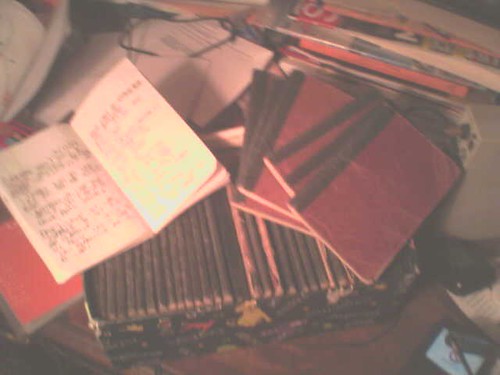
Some people swear by Moleskine notebooks. Me, I’m all about the 6 1/8″ x 3 3/4″ 72-page Oxford Memo Book, stock number 6096 1/2. They look old school, age well after months in my back pocket, and never fall apart.
Unfortunately, the dude at the stationary store told me that they are being discontinued in that size. I, for one, am having a cow.
Emails with the Esselte Corporation, trying to order even just a single case, have proved fruitless. Googling and eBay searching have been similarly frustrating. As I embark on occasional missions to various lower Manhattan stationary stores, I figured I’d post a cyberplea, as well, and make an offer…
If anybody comes across any 6096 1/2s (or the ledger-lined 6094), I will gladly cover the costs of purchase and shipping, and will send a care package including a mix CD and other goodies. Drop me a line, y0!