The sixth inanongoingcollectionof functional webpages and dork tools (excluding any/all Google programs).
o Since the cat seems to be out of the bag, the coolest thing ever: Critical Metrics, a rated singles aggregator. It begins.
o OttoBib — An automated bibliography generator. Just enter ISBNs and click “Get Citations.” Man, I wish I had this when I was in school.
o BookMooch — Trade used books with peeps. (Thx, VB.)
o eSnips.com — Semi-permanent freebie web storage, up to 1 GB. (Word, Dean.)
o Writer’s Dreamtools — Their URL is no joke.
Missing baseball, I recently spent some time with Roger Angell’s Season Ticket, which contains some of the best writing I’ve ever read about the pleasures of being a fan. That Angell’s fandom happens to be of baseball often feels incidental. Here is a rain-delayed in game in Toronto:
Then it rained — downward and side-blown sheets and skeins of water that streamed down the glass fronting of the press box, puddled and then pounded on the lumpy, too green AstroTurf playing field before us, and emptied the roofless grandstand around the diamond. Glum descendant clouds swept in, accompanied by a panoply of Lake Ontario ring-billed gulls (a celebrated and accursed local phenomenon), who took up late-comer places upon the long rows of backless aluminum benches in center right field and then settled themselves thickly across the outfield swamplands as well, where they all stood facing to windward, ready for a fly ball, or perhaps for a visiting impressionist French film director (“Quai des Jays,” “Toronto Mon Amour”) to start shooting.
(It also happens to be available for $1.00 from AbeBooks.com, or one cent from Amazon.)
“Go Where I Send Thee” – Golden Gate Jubilee Quartet (download here)
from Gospel Music (2006)
released by Hyena Records (buy)
(file expires January 12th)
We can talk all we want about popcraft, but the most genuine hooks are those in folk music — real folk music, that is, the type that existed before recordings. In fact, after a song has been passed from generation to generation and continent to continent, all that’s left is what people can remember: hooks.
Like the Beverly Hills Teens theme song, “Go Where I Send Thee” — performed here by the Golden Gate Jubilee Quartet — has been lodged in my head for most of my life without me ever owning a proper recording. I suspect I learned it from a lily-white Pete Seeger rendition, but I’m not really sure. (The 1937 GGJQ version is from Joel Dorn and Lee Friedlander’s awesome Gospel Music mix.)
In Folk Songs of North America, where it is labeled “The Holy Baby,” Alan Lomax traces it as such:
Versions of this ancient mystic song have been recorded everywhere in Europe. Archer Taylor (Journal of American Folklore, LXII, p. 382) suggests that its origin may be found in Sanskrit, but that all European versions are probably derived from a Hebrew chant for Passover (Echod mi Yodea, first printed in Prague in 1526). The earliest known English translation of the Jewish religious folk song appeared in the seventeenth century, but a number of distinct forms soon developed.
To my ears, “Go Where I Send Thee” — the melody at its core, anyway, the specific part that never left me — doesn’t sound particularly like any of these cultures, the American South included. The refrain, the little drop between “send” and “thee,” just sounds like something I remember, everything whittled away except for its exact emotional effect. To paraphrase Frank Zappa: Folk isn’t dead. It doesn’t even smell funny.
And… we’re back. This year, the Frow Show will run every other Wednesday on the Ropeadope Podcast Network. Hooray for regularity. Insert joke about eating lots of bran here. (Thanks to Ace Cowboy for calling me out.)
Episode 10: the autumn rollover An autumn mix burned for friends.
1. “Beverly Hills Teens Theme” – ??? (from the interweb)
2. “Frow Show Theme” – MVB
3. “Suffer For Fashion” – Of Montreal (from Hissing Fauna, Are You the Destroyer?)
4. “Mikes Jones vs. Britney” – Diplo (from Hollertronix, v. 2 EP)
5. “If I Were Only A Child Again” – Curtis Mayfield (from Four Tet: DJ Kicks)
6. “In A Different Light” – The Bangles (from Different Light)
7. “Divine Hammer” – The Breeders (from Last Splash)
8. “Autumn Sweater” – Yo La Tengo (from I Can Hear the Heart Beating As One)
9. “The Mountain Low” – Palace Music (from Viva Last Blues)
10. “All Downhill From Here” – Jim O’Rourke (from Insignificance)
11. “Sanddollars” – Why? (from Elephant Eyelash)
12. “I’d Love Just Once To See You” – The Beach Boys (from Wild Honey)
13. “She Smiled Sweetly” – The Rolling Stones (from Between the Buttons)
14. “Absolute Lithops Effect” – The Mountain Goats (from All Hail West Texas)
15. “Harvest Moon” – Cassandra Wilson (from New Moon Daughter)
16. “Thank You For Sending Me An Angel” – Talking Heads (from CBS demos)
17. “I Wanna Be Your Lover” – Bob Dylan (from Biograph)
18. “Brokedown Palace” – Bonnie “Prince” Billy (from Pebbles and Marbles, 2004 summer tour)
Happy 2007. Still recovering from various reveleries, but here is another Greatest Miss: a brief item circa November 2002 for a now-defunct (I suspect) NYC freebie paper whose name I don’t recall about the sound art gallery, Engine 27. I picked up copies for a few months after I submitted it, but never saw it in print and never heard back from the editor. I was a little premature in calling Engine 27 firmly established, it seems, but so it goes. Diapason is still kicking.
Engine 27’s Rational Amusements
by Jesse Jarnow
Lower Manhattan has long been rife with the so-called rational amusements: scientific dream factories like PT Barnum’s American Museum where exotic worlds might be conjured. And where Barnum displayed the curios of destinations fantastic, Jack Weisberg’s Engine 27 multi-channel sound gallery allows visitors to walk through jungle darkness, strange symphonies erupting from every corner. Housed in a decommissioned TriBeCa firehouse, the space open to the public is little more than a long, dark room adorned by 16 custom-built speakers. Below the floor, though, mind-bending technology hums and directs sound, creating what managing director Eric Rosenzveig calls a “physical three-dimensional landscape.”
Multi-channel sound-as-art has existed at least since Iannis Xenakis and Le Corbousier’s 1958 Brussels World’s Fair collaboration with Edgar Varése, but the form seems to have blossomed in the past two years, with the firm establishment of not only Engine 27 and Michael Schumacher’s midtown Diapason Gallery, but a nod from the Whitney, who included a sound room in their most recent biennial. “I think [one of] the primary directions in music in the past 10 years has involved breaking open the stereo field,” says Rosenzveig, who thinks “all music can work well in a multi-channel environment, if the artist is interested in addressing [one].”
Electronic musician Tetsu Inoue, who had never created for multi-channel before, sculpted the rich Active Dot (for 16 lines). Though he admitted having trouble adjusting to the new spatial palette, he claims that after his residency, “CD format is kind of boring, very timeline based.” Engine 27’s first batch of artists-in-residence, a “Noah’s Ark” of 30 composers combining invited guests and open-call applicants, tried to sample a multitude of aesthetics. As highfalutin as the specifics of Engine 27 are, the results played like rotating weekly features at one of William Gibson’s futuristic stim-parlors: magical, and all for a fair buck.
“New Year’s Eve” – Stephan Mathieu and Ekkehard Ehlers (download here)
from Heroin (2001)
released by Orthlorng Musork (buy)
“New Year” – The Breeders (download here)
released by 4AD
from Last Splash (1993) (buy)
I like the contrast of these two takes on New Year’s. Stephan Mathieu and Ekkehard Ehlers’ field-recorded fireworks are literally kinetic energy. Though they are violent chemical reactions, they are also soft, as if muffled by a snowfall. Certainly, the swelling organ helps — a fantastic exercise of bare melody finding form in chaos.
“New Year,” meanwhile, is the sun-blinded morning after and all (conceptual) potential energy. The lead track from Last Splash, it is two minutes of indie-surf glee whose main purpose is to set up what follows. Like slowly remembering the impossible resolutions made in the ecstasy of revelry, its ending is profoundly unsatisfying without a dramatic statement to follow. Below the lyrics, in the liner notes, there is a literal parenthetical clarification: “(stage direction: suspenseful point).” The Breeders came up with the classic bass-drop intro to “Cannonball.” If only every year could start so well.
(Thanks to the too-oft-neglected-but-still-bloody-awesome ‘buked & scorned for introducing me to “New Year’s Eve” last December. I should probably check out the rest of Heroin now, huh?)
By morning, I will happily off-grid for a week, back in action on 12/28 or so. In the meantime…
Rescued from the cabinet of VHSs at my father’s house on Long Island (and digitized by my buddy, LB), it’s Think Big, the 1987 inspirational video starring the New York Mets’ Gary Carter, Mookie Wilson, and Roger McDowell!
See them mime (on the field at Shea!) to hilariously synthed out rock tunes written just for them! Hear Gary Carter attempt a Pee-Wee Herman imitation! Dig the late ’80s conception of proto-internet video baseball! Get inspired!
I remember asking my parents to get Think Big for me. I don’t think I ever bought into to it, though. Even when I was nine, it was unbearably corny. But it was neat to see Mets players clowning around like they were the Beatles or something. Really, the coolest part was the video baseball. 100% awesome!
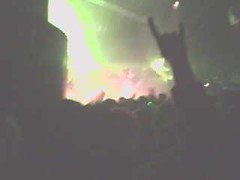
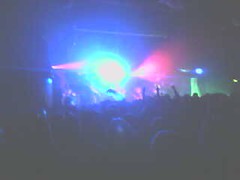
“You fucked my girlfriend with a cellphone!” said GWAR’s Number One fan, upon encountering the band in Hell, shortly before they chopped into him and he squirted the sixth or seventh round of fake blood on the audience. Before that, though, the band clarified: “We didn’t fuck your girlfriend” (pause) “…we raped her. And it wasn’t a cellphone. It was a phone booth.” (Cheers.) Then blood. Like every between-song skit — which also included Adolf Hitler, Arnold Schwarzenegger, George W. Bush, and Jewcifer — it was scripted with the obvious punchline: cover the audience in some kind of fluid. There was also a fake cock and a lot of fake cum.
“There used to be a lot more blood,” said my friend, who’d seen GWAR “10 or 20 times.” “It used to start gushing as soon as they hit the stage. It was a lot better.” He’d never seen GWAR — who celebrated their 20th birthday last year — in any place larger than Irving Plaza, the small ballroom where we saw them tonight. It makes sense. After all, any bigger and the blood cannon (placed at crotch level and operated by a dude in a leather thong) wouldn’t be able to reach the back of the room.
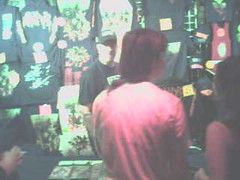
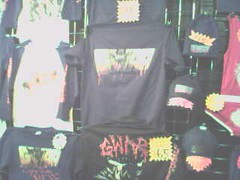
Besides the wall of tee-shirts and branded underwear at the merch table, there was also a veritable metal record store. Besides discs from GWAR and their two openers, there were also long cardboard cases filled with their brethren like Cannibal Corpse, Cattle Decapitation, Born Into Pain, and Destroy Destroy Destroy. It was a one-stop subcultural shop.
GWAR have been doing this for twenty years. With their anonymity-granting costumes — which resembled, well, bad guys from Teenage Mutant Ninja Turtles — they could tagteam members for generations (if they haven’t already). GWAR could still be playing in decades, when metal feels quaint, like bluegrass does to us. One can never underestimate the power of being covered in fake blood, though. If being covered in sweat is the sign of an authentic ecstasy, then GWAR do all the work, virtually guaranteeing that anybody who wants to can have a literally physical, visceral experience. And that is a pretty good concept for a band.
I have a playlist of all the quiet songs I can listen to late at night or right when I wake up. Usually, it’s a matter of finding one or two tracks on a given album. As such, sometimes I wonder if I automatically devalue (say) Iron & Wine’s music because I can drop nearly any song from Sam Beam’s catalogue arbitrarily into the shuffle. Likewise, the ultra-prolific Akron/Family’s forays into the big purdy — like the ambiguous and beautiful “Gone Beyond” from Meek Warrior — sometimes seem too easy. The untitled last track from their self-circulated radio session demos for their next album (produced by Ween collaborator Andrew Weiss, out in spring, can’t wait to hear it, etc), falls into this category.
Besides the lovely rising turn on “moonlight” and “in the daytime,” it doesn’t make much of a case for being something besides a generic psych-folk ballad. The images are even a little hackneyed (“all we see is moonlight drifting from dream to dream”), but somehow it all adds up and makes me want to listen to it repeatedly. Especially in the context of A/F — whose typically ambitious demos also include their usual ecstatic chants (“Ed Is A Portal”), ragged Americana (“Sophia”), and oddball/handclap grooves (untitled no. 1) — it is an inevitable coda. As a single track, almost anybody, in almost any genre, in any decade of the 20th century could have written it. That’s all well and good. Mostly, I like it — especially the woozy faux-Hawaiian slide interlude — because it sounds fucking fantastic when I’m almost asleep.