Book review:
Tearing Down the Wall of Sound – Mick Brown
He’s A Rebel – Mark Ribowsky
Inside the Music of Brian Wilson – Philip Lambert (London Times)
Track reviews:
“Open Your Heart” – Lavender Diamond (PaperThinWalls.com)
“The Pushers” – Wooden Wand (PaperThinWalls.com)
“Omstart” – Cornelius (PaperThinWalls.com)
“The Crystal Cat” – Dan Deacon (PaperThinWalls.com)
Album reviews:
The Search – Son Volt (Paste)
Headphones Jam – Phish (Relix)
Page McConnell – Page McConnell (JB.com)
Film review:
Venus
Columns:
BRAIN TUBA: Department of Ombudsmanship
BRAIN TUBA: The Gentrification Tax (A Reasonable Proposal)
Songs:
(accompanying my lovely buildingmate in her 365Songbird Project, my contribution in parentheses)
“My Personal Genius” (guitar)
“The Tambourine Takes Soul” (bass)
“Kevin Federline is a Douchebag” (bass/vocals)
“Jesse’s Eye” (bass/inspirado)
Only in print:
o April/May Relix (album art cover): mini-essay on the future of album art; album reviews of Phish, Tin Hat, and Kieran Hebden and Steve Reid; book reviews of Billy Martin’s Riddim and Mitch Myers’ Boy Who Cried Freebird. All typos added by Relix staffers, for your convenience.
o Paste #30 (Modest Mouse cover): film review of First Snow, DVD review of the Decemberists.
o Paste #31 (Hold Steady cover): album review of Patti Smith, book review of Roni Sarig’s Third Coast, film review of Aqua Teen Hunger Force Colon Movie For Theaters.
Yo La Tango: sic’cest ever!
Yo La Tengo at Webster Hall
29 April 2007
Oneida opened
I Feel Like Going Home
From A Motel 6
Pass the Hatchet, I Think I’m Goodkind
Last Days of Disco
The Room Got Heavy
The Weakest Part
Beanbag Chair
Mr. Tough
Song for Mahlia
Don’t Say A Word (Hot Chicken #2)
Sugarcube
Styles of the times
Big Day Coming > (fast version)
Watch Out For Me, Ronnie
The Story of Yo La Tango
*(encore 1)*
The Race Is On Again
Dreaming (Sun Ra)
Tom Courtenay (acoustic version)
*(encore 2)*
Gates of Steel (Devo)
My Little Corner of the World (Bob Hilliard & Lee Pockriss)
I love Paul Williams’ writing on Bob Dylan. Like the baseball columns of Roger Angell, it’s clear that Williams is a fan and can completely communicate that experience. Frequently, of course, he gets carried away. Nonetheless, it is always valuable. In the best stretches of his multiple books about Dylan, it really seems as if Williams holds the key to understanding what Dylan does.
Here, Williams unpacks what is amazing about live performances. He is speaking generally, though what says is more easily applicable to Dylan’s linear/one-man style than most other types of musicians:
The performance is a unit of time. If you think of a movie camera recording the painter’s every brush stroke from the moment and place where s/he starts on the canvas to the place and moment where s/he finishes, you will understand that every painting is a kind of straight line, a movement, a performance, compressed upon itself… as the painting compresses time into something that can be felt all at once, so the performance takes human experience and stretches it out so that instead of just feeling it altogether (as we do in life) we feel it a morsel at a time, in a sequence. (from Performing Artist, 1974-1986)
He resorts often to hyperbole, though it is of the most beautiful, infectious sort. On the July 1st, 1984 rendition of “Tangled Up in Blue” that I can’t really imagine being objectively very good (though am certainly willing to check it out):
The version on Real Live (from London, July 7) is so similar I’m not sure I can articulate what makes the two performances different; yet the difference is as unmistakable as that between an ordinary starry night and the same instant after a lightning bolt has shattered the sky. (from Performing Artist, 1974-1986)
Williams is passionate in his adversity, too, publishing a book-length defense of Dylan’s 1978 conversion to Christianity titled Dylan — What Happened?). Purportedly, Dylan purchased copies to distribute to his friends, letting Williams act as his surrogate. When most fans were abandoning Dylan, Williams committed to Dylan’s new music as hard as he could without becoming a disciple of Christ himself, and in the process teased out some great stuff about what it really means to be a listener. “Some people see this is a threateningly anti-intellectual move from someone they’ve always related to on an intense intellectual level,” he wrote.
The old thing of all of us being in the same psychic space at the same time listening to the same new record albums just doesn’t work anymore. Not that I think Dylan expects it to — but I think that’s what a lot of us still expect of Dylan, that he’ll bring us the news. And that’s why we’re so confused and upset about the news he brought us this time. We keep thinking his news is our news, you see. (from Watching the River Flow, 1966-1995)
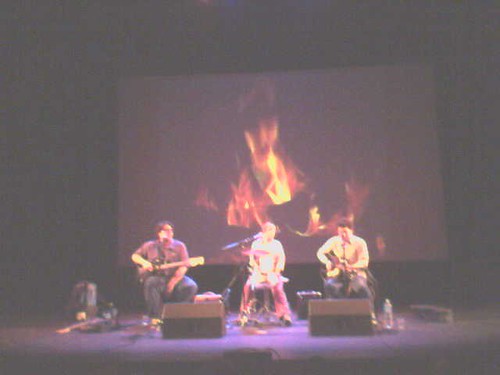
Yo La Tengo at Skirball Center, NYU
25 April 2007
Billed as ‘Around the Campfire with Yo La Tengo.’ Ira on acoustic guitar, Georgia on snare/hi-hat, James on bass. Q&A between each song.
Tom Courtenay
Our Way To Fall
You Can Have It All (Harry Wayne Casey)
Tiny Birds
Rocks Off (Rolling Stones)
Better Things (The Kinks)
Now 2000
Nowhere Near
Stockholm Syndrome
Autumn Sweater
Speeding Motorcycle (Daniel Johnston)
Episode 18: First the Dishes, then the Revolution!
…(as seen over the sink at Rubulad)…
Listen here.
1. “Take Me Out to the Ballgame” – Bob Dylan (from Theme Time Radio Hour #4: Baseball)
2. “Thou Shalt Always Kill” – Dan Le Sac vs. Scroobius Pip (from Thou Shalt Always Kill EP)
3. “Frow Show Theme” – MVB
4. “Bird Flu” – M.I.A.
5. “Earth Intruders” – Bjork (from Volta)
6. “Boy Looka Here” – Rich Boy
7. “Je Veux Te Voir (Original Mix)” – Yelle (from Mashed III compilation)
8. “????” – Ike Reiko (from Kokotsu no Seka)
9. “Nega (Photograph Blues)” – Gilberto Gil (from Gilberto Gil)
10. “This Could Be The Night” – Modern Folk Quartet (from Back to Mono box set)
11. “Backwater” – The Meat Puppets (from Too High To Die)
12. “Stick Your Tail In the Wind” – Summer Hymns (from Voice Brother and Sister)
13. “Portrait in the Clouds” – Wooden Wand (from Second Attention)
14. “Painted Eyelids” – Beck (from One Foot In the Grave)
“Thou Shalt Always Kill” – Dan Le Sac vs. Scroobius Pip (download here)
from Thou Shalt Always Kill EP (2007)
released by Lex (buy)
Yeah, “Thou Shalt Always Kill” is novelty hip-hop, British, and dorky, but it also feels like an achievement, or at least something I’ve been listening to over and over and over. Sure, there are all kinds of clever pop references (“thou shalt not wish your girlfriend was a freak like me”), but there are just as many moments that just feel real (“thou shalt not fall in love so easily”). It’s one popped balloon after another, keeping it real as real, in the highly relatable dialect of music geekdom. I likes.
Incidentally, I found this tune via Critical Metrics, a site I’ve been doing some editing work for, which I whole-heartedly endorse as a dope way to discover new music. A track review aggregator, CM launched officially on Friday, via a BoingBoing interview with our grand poobah (and my ex-neighbor) Joey Anuff. Blender weighed in as well. (Here is CM’s page for “Thou Shalt Always Kill.”)
o CitiField is emerging a few dozen yards from the outfield fence, a superstructure that looks not unlike the half-completed Death Star in Return of the Jedi. It’s certainly ominous. With nobody working on it during the weekend games, it looked like it could either be a construction or demolition project. Like a first trimester fetus in a sonogram, bits of what I imagine will be the first base bleachers are the only part currently recognizable as a ballpark.
o I’m deeply suspicious of the asymmetric layout of the new field. I dig Shea Stadium because it is Platonic: what a baseball field should look like in the best of all possible worlds. Allegedly, CitiField is to mimic old-time ballparks, with its facade imitating Brooklyn’s Ebbets Field. But old fields’ dimensions were idiosyncratic because they were often forced into the confined footprint of a city block. It just seems false.
o Aha, another reason baseball is unique: its complete system of elegantly nested units. (Huh-huh, “nested units.”) It can be broken down into formal segments, growing larger and more complex: single pitches (their motion over the plate), at-bats (the full drama of how to work a batter), plays (individual sets of action), innings (slightly larger sets, with dramatic unity), games (the most basic currency of baseball), series (how two teams stack up during a given few days), and seasons (ultimately, determining who is best, and starting over). Matt commented about the micro-macro qualities of the game at this point last year, and he’s totally right. The relationships between the levels are unbelievably dynamic. As above, so below. Or maybe it’s the other way around.
o Likewise, there are all kinds of different levels one can pop back and forth between when talking during a game. Besides the formal elements, listed above, there’s also the matter of lore: individual player narratives, team rivalries, and the like, as well as the even grander arc of baseball history.
o One can employ any one of the elements to figure out why the fuck the Mets melted in the 7th this afternoon. For example, one can blame Shawn Green’s misplay of Scott Thorman’s drive into the right field corner, which should’ve been the third out. Or one can blame the evolution of relief pitching into righty/lefty specialists used for one or two batters, even if they’re clearly in the groove — Willie Randolph having pulled Ambiorix Burgos so Scott Schoeneweis could face Kelly Johnson (walked) and Edgar Renturia (three-run home run into the Mets’ bullpen). Or one can blame Schoeneweis for bad pitching, or anybody or anything else. Really, the Mets lost, another unit completed.
A reasonable/utopian proposal to rebalance the cultural ecosystem.
If it can be proved that:
1.) In a neighborhood…
a.) …there has been a recent boom in high-value residential real estate…
b.) …the average rent for a commercial property has increased.
2.) An institution in that neighborhood…
a.) …is of cultural value…
b.) …has been open for five years or longer…
c.) …was able to operate at the original rent…
d.) …cannot viably function under the new rent.
Then:
The neighborhood’s new residents should be made to pay a Gentrification Tax to cover the difference between the institution’s original rent and the current market value of the property, as well as any attendant costs for the legal enforcement of the law.
Perhaps it is true of all sports, but magical realism/fabulism seems to go particularly well with baseball, from Philip Roth’s malfunctioning Ruppert Mundys of the Great American Novel to the entire career of W.P. Kinsella (who I’ll probably post more about as the season moves along). A good answer is suggested by George Plimpton in his own contribution to the genre, The Curious Case of Sidd Finch, about an aspiring Buddhist monk who can pitch 168 miles per hour (and does so over several games with the 1985 Mets):
Baseball is the perfect game for the mystic mind. Cricket is unsatisfactory because it has time strictures. The clock is involved. Play is called. The players stop for tea. No! No! No!… On the other hand, baseball is so open to infinity. No clocks. No one pressing the buttons on stopwatches. The foul lines stretch to infinity. In theory, the game of baseball can go on indefinitely.
On Finish’s first big league performance:
Sometimes in a stadium, if it is tense, and the place has a good crowd, enough people identify with the actual flight of the pitch ball — an exhalation of breath — so that the pitch is accompanied by a slight whoomph. With the first ball that Finch threw there was no time for any kind of reaction: we heard the slam of the ball driving the air out of the catcher’s mitt with a high pop! — audible, I suspect, in the parking lot beyond the center-field fence. This was followed by a high exclamation from Reynolds, a kind of squeak, as he stood up from his stance, reached into his glove, and began pulling the ball free.
Several more thoughts about Tom Stoppard’s Coast of Utopia, which I finished seeing last week, and finished reading yesterday…
o I could really go for another three parts. With the recent appetite for serial entertainment like Lost and Harry Potter, it’d be wonderful for a writer of Stoppard’s caliber to tackle a project as epic. Perhaps that’s exactly what Coast of Utopia already is.
o Three women next to us left after act I of part III. What the fuck? Did they make it all the way and give up? Were they tourists who just wanted to see a show at Lincoln Center?
o For numerous reasons — rhythm, dialogue, conceits — it could never translate to film. Does the fact that it can’t be mass entertainment make it pretentious? (It is, of course, but for other reasons, often indistinguishable from why it’s so grand.)
o Perhaps the most beautiful set in the whole show: perfectly vertical Christmas lights lowered from the rafters, creating the illusion (especially in the balcony) of being suspended in the midst of a hyperreal starry night.
o Throughout, Stoppard juggles characters, plotlines, philosophical arguments, and — in part III, Salvage — it was amazing to watch him bring them all to conclusions. In doing so, Stoppard sometimes stepped out of his usual voice. On paper, while supremely eloquent, some of the Big Speeches lack Stoppard’s usual multi-layered verve. But, on stage, calling on the audience’s collective experience with the characters, they were among the most dramatic parts of the trilogy. Alexander Herzen, reflecting:
I sat in this char the first morning I woke up in this house. I’d just arrived in England, and for the first time… for the first time since Natalie died… no, from before that, that I don’t know since when… but for the first time in a long time, there was silence. I didn’t have to talk or think or move, nothing was expected of me, I knew nobody and nobody knew where I was, everything was behind me, all the moving from lace to place, the quarrels and celebrations, the desperate concerns of health and happiness, love, death, printer’s errors, picnics ruined by rain, the endless tumult of ordinary life… and I just sat quiet and alone all that day, looking at the tops of the trees on Primrose Hill through the mist.