The suicide of former Grateful Dead keyboardist Vince Welnick on Friday saddened me in a way I couldn’t have predicted. As a latter-day Deadhead, I never had much use for him. In large part, that is because his tenure fell during Jerry Garcia’s final half-decade, a period of terminal musical decline. In the proverbial history book, Welnick is a footnote.
But he was also a real dude, who — until last week — was busting his ass trying to make a living playing keyboards (most recently with various Dead cover bands). His story, as posted by his friend Mike Lawson, is heartbreaking. Welnick was depressed, Lawson writes, because his ex-bandmates never invited to any of the periodic Dead regroupings. This, in part, seems to have happened because — while on tour with Bob Weir and Ratdog — Welnick overdosed in the back of the bus, and was subsequently shoved unceremoniously into a cab and sent to the emergency room as a John Doe.
There’s more, of course, throughout both Lawson’s post and the subsequent thread. In a way, with its neat and logical narrative, it makes perfect sense of what happened — something extraordinarily rare. But just because the story makes sense and has an ending doesn’t mean that anything is resolved, or better. Sometimes, the music just doesn’t work, and that might be the scariest ending of all.
“Screenwriter’s Blues” – Soul Coughing (download here)
from Ruby Vroom (1994)
released by Epic (buy)
“Screenwriter’s Blues” – Soul Coughing (download here)
recorded 3 February 1997, Tokyo, Japan
released by Kufala (buy)
“Screenwriter’s Blues” – Soul Coughing (download here)
recorded 15 June 1992, Knitting Factory, New York City, NY
(files expire on June 9th.)
I busted out Soul Coughing’s Ruby Vroom while doing the dishes tonight, and re-fell in love with an old favorite, “Screenwriter’s Blues.” The album version, of course, is the proverbial Platonic motherfucker. That is, it’s good and definitive. I love Doughty’s mythical descriptor, “and men built a Los Angeles,” as if there could be more than one. Mark de Gli Antoni’s cyclical horn sample is the sonic equivalent of “the imperial violet” cast when “the sun has charred the other side and come back to us.” The whole song boils down to that, and the way Doughty sounds the word “luminous,” disappearing into a wispy, baubled L.A., like a city encased in a raindrop.
The jammy-jam 10-minute live version, recorded in Tokyo in 1997 (and released as part of Kufala’s great Soul Coughing archival series), expands on this vibe. Doughty launches into the spoken word over an ambient noir-groove. Imperceptibly and impeccably, the band snaps from their sparse weirdness into a complete reimagining of the song that occasionally calls on elements of the original recording, but is mostly just its own unique entity.
A mostly unformed rendition from an early Knitting Factory gig, in June 1992, reveals exactly how much work went into the song. The idea is there, clearly. “You see the grid of light below the plane descending on the airport,” Doughty recites during one of the song’s better excised lines, but it clearly needed some editorial attention — which it thankfully got — not to mention some music beyond a drum groove. Nearly all of the song’s final lines are present in some variation. The creative process in action, though only really relevant as a footnote to the other two versions.
Over the weekend, I lent my friend Mike a copy of Gates of Eden, a book of short stories by Ethan Coen of the Coen brothers. Each piece is like a miniature, unmade Coens’ picture. “Have You Ever Been To Electric Ladyland” (a statement, not a question, in the hands of Coen) is one of my favorites.
The opening two graphs of the story still blow my mind. In 93 words, Coen establishes a legit voice with its own phrasing, a rough sense of who is speaking, who he is interacting with, and (most importantly) a momentum, propelled by the fact that something has happened. And it all sounds, uh, Coenesque taboot, filled with awkwardly incomplete thoughts, nervous side-chatter, and an often subliminal throughline. The whole story is just masterfully timed and well worth reading.
I don’t know. I do not know. A sick fuck. A sick, twisted motherfuck, that much is obvious.
An individual name does not come to mind. I’m not saying it was a stranger. Though it could be. Senseless, random. Or not random. A stranger, but not random. Because, officer, if you have, like me, a certain renown, name in the papers, well — I don’t have to tell you that there are nuts out there. You know that better than anyone. A lot of nuts. And this, clearly — this is nut’s work.
Features:
“‘Circuit bending’ lets old toys play tunes,” Associated Press
“Unleash the Love,” Times Herald-Record (interview with Mike Love)
“I Know There’s An Answer,” wunderkammern27.com (interview with Brian Wilson)
Album reviews:
Estudando O Pagode – Tom Zé
Surprise – Paul Simon
The Wind at Four to Fly – the Disco Biscuits
Congotronics 2: Buzz ‘n’ Rumble From the Urb ‘n’ Jungle – various
Really Don’t Mind If You Sit This One Out – Mushroom
self-titled – Carneyball Johnson
‘Sno Angel – Howe Gelb
Live reviews:
Broken Social Scene at Webster Hall, 28 January 2006
Marc Ribot at Issue Project Room, 16 March 2006
Medeski, Martin, and Wood at the Society For Ethical Culture, 6 April 2006
Tristan Perich, Corn Mo, and Captured! By Robots at North 6, 6 May 2006
Jim O’Rourke at the Stone, 16 May 2006
Book reviews:
Black Swan Green by David Mitchell, published in Paste #21
Stumbling on Happiness by Daniel Gilbert
Columns and misc.:
BRAIN TUBA: Back to the Future
BRAIN TUBA: Fairweathering
web notes for AUX compilation
Only in print:
o June Relix (Pete Townshend cover): album reviews of Billy Martin, Billy Martin and Grant Calvin Weston, Steve Reid and Kieran Hebden, Glenn Kotche, Marley’s Ghost, Johnny Cash; live review of the Rhythm Devils; DVD review of Leo Kottke.
o Paste #22 (Bob Dylan cover): Jeff Tweedy entry in “100 Best Living Songwriters feature, album review of The Raconteurs.
o May Hear/Say (Taking Back Sunday cover): album reviews of Danielson and Elf Power.
There’s an old SubGenius maxim that runs that if Satan can use the Scriptures to his own ends, then SubGenius slackmaster J.R. “Bob” Dobbs can quote anything to prove anything. Reading pop psychology can sometimes feel like that. Harvard prof Daniel Gilbert and his thoroughly enjoyable Stumbling on Happiness are cut from the same contrarian cloth as New Yorker staffer Malcolm Gladwell (who gives good blurb on the book’s Amazon page).
Gilbert hangs his arguments about what makes humans happy from a narrative of anecdotes. In short, he says, “when we think of events in the distant past or distant future we tend to think abstractly about why they happened or will happen, but when we think of events in the near past or near future we tend to think concretely about how they happened or will happen.” This is what we must consider, he argues, when we think about how to be happy (which, presumably, is what we want).
The endless stream of footnoted studies is powerfully dizzying. In one test, subjects “imagined the poster on their wall, noted how they felt when they did so, and assumed that if imagining the poster on the wall made them feel good, then actually seeing it on their wall would probably do the same. And they were right.” Score one for intuition. But 25 or so pages earlier, Gilbert writes that “when humankind imagines the future, it rarely notices what imagination has missed — and the missing pieces are much more important than we realize.” So… we shouldn’t trust intuition?
At one point, Gilbert uses graphs to show that eating at the same restaurant over and over can be clinically more satisfying than eating at a variety of restaurants over the same period of time — which goes a long way towards justifying my San Loco obsession, but could just be rhetorical fancy-pantsing (or, in other words: anything to prove anything).
Surprisingly, the end result of Stumbling on Happiness is a cohesive composite of a deeply elusive emotion. Gilbert never puts his finger on exactly what happiness is, but who could? Instead, he provides a vocabulary (see: “presentism,” “pre-feeling,” etc.), to chart its idiosyncratic dartings. If that all sounds a l’il fuzzy and self-helpy, then I suppose it is, but Gilbert offers no cure-alls, just methods of observing one’s own thoughts mid-flight. Sure, Dobbs or Gilbert can use anything to prove anything, but Gilbert has chosen to prove the existence of happiness, and that’s not such a bad goal to have.
One more baseball posting to close out the week…
Two excerpts from Catch You Later: The Autobiography of Johnny Bench by Johnny Bench and William Brasher. (see also: Johnny Bench by, uh, me.)
1.
1972 World Series, versus the A’s.
I, meanwhile, had to prepare for a World Series not against Baltimore and Mr. Brooks Robinson, but against Charlie Finley’s Oakland A’s: mustaches, mules, and all.
We were the bad guys. It was 1972, the streets belonged to the people, flower children were alive and well, and the Cincinnati Reds were the Establishment being shoved up against the wall by the A’s from Berkeley.
We wore white suits at home, gray on the road, with low-cut socks and black polished spikes. They wore gold, green, and white uniforms in every combination, shiny high-cut silks, and white spikes.
We were clean-shaven with trimmed, short hair (Pete still wore a flat top) and no sideburns. They were longhairs, with sideburns and mustaches — thanks to Charlie Finley’s contest to see who could grow the most stylish upper lip — and the results were muttonchops, handlebars, and Fu Manchus.
…Before the series began in Cincinnati, I got together with Reggie Jackson and went out for something to eat. … Later I drove him back to the hotel, Reggie was on crutches, and when we went up past a few players’ rooms, I smelled the sweet, unmistakable odor of marijuana. A couple of the Oakland A’s, the American League representatives in the World Series, were smoking dope. That really shook me. I thought, “How in the world can they be doing this?” (pp. 109-111)
2.
1973 National League Championship Series, versus the Mets
“Grab a bat!” I yell. “Everybody grab a bat! Make sure Pete gets off the field.”
Sparky takes it up, mobilizing the whole team into a civil defense corps. We’ll go out there swinging to get him if we have to. Our hitter slaps a grounder, Pete runs a few steps toward second, then dashes for our dugout.
“Here they come!” someone shouts, and the fans are pouring over the walls and onto the field. Pete bulls his way, knocks a few kids on their cans, and makes it into the dugout. By now the people are on the dugout roof and coming over the top. I stand there with the fat part of a bat in my hand. I swing at a kid who comes at me and rap him in the shins. I can hear the thwock against the bone. He yelps and drops back and others back off. (p. 144)
“Meet the Mets” – Yo La Tengo (download here)
from Yo La Tengo Is Murdering the Classics (2006)
released by Egon
(file expires on May 31st.)
Every one of the 30 tossed-off covers on the terrible-by-any-objective-standard Yo La Tengo Is Murdering the Classics will be endearing to somebody; the only question is which one. It’s kind of a neat effect, and it makes the band seem that much more personal. For me, it’s “Meet the Mets,” the closest the team (from whose lore YLT drew their name) ever came to a theme jingle. Though it was recently replaced — officially, anyway — by the metallic shit-pop production “Our Team, Our Time,” “Meet the Mets” still gets an early inning airing and sing-along. Young Manhattanite recently posted a delightful mp3 history of the Mets’ various songs over the years.
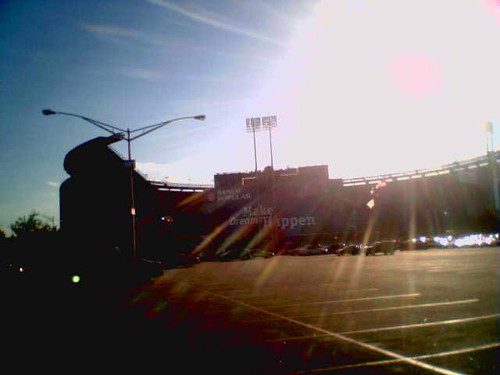
(Visible under the 7-train tracks is the Casey Stengel bus depot.)
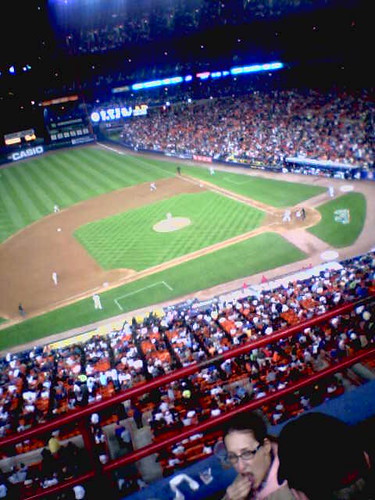

(“Take Me Out to the Ballgame,” 7th inning stretch.)
Walking from home plate at Shea Stadium, across second base, through the outfield, over the fence and to the other side of the parking lot, one arrives in Willets Point, a sprawling near-shantytown of car repair places. Before tonight’s five-hour, 16-inning blowout victory against the Phillies, Tony and I wandered through Willets Point at Magic Hour. The roads were unpaved and riddled with puddles. There were chop shops, pre-fab warehouses, body specialists, and lots filled with tires. Tony said it felt like being suddenly transported to a third world nation. He wasn’t wrong. It was pure urban anarchy.
When the Mets’ new stadium goes up in a few years, it’s a sure bet that somebody will have some whizbang revitalization plans that will involve the removal of the unsightly car repair places (the cheapest in the boroughs, supposedly) currently clogging up valuable waterfront real estate. For now, though, the scrap metal glows in the Queens County sunset.
You can see Shea’s upper deck in the distance…





“Feels Blind” – Bikini Kill (download here)
from Bikini Kill EP (1991)
compiled on The C.D. Version of the First Two Records (1994)
released by Kill Rock Stars (buy)
(file expires on May 30th.)
Sometime during junior high school, at summer camp, my friend (a girl, it should be noted) played me Bikini Kill’s “Feels Blind.” I was just learning to play guitar, and the three-note riff was irresistible. I loved how it started off clean with the nice neat martial beat, and then the band just went apeshit. The intro verse was lovely, I thought: a clever melody and cool lyrics, and then it just disappeared into the full-throttle punk-rawkness of it all — and that was awesome, too! And then Kathleen Hanna was screaming something about how “as a woman, I was taught to be hungry.” Then, the climactic chant: “I eat your hate like love.” Needless to say, we played it in our summer camp band (we were called “Umlaut” that year). She played bass. I was part of the unnecessary army of guitarists. It was fun.
And sometime after that, while visiting the aforementioned girl in DC, I bought myself Bikini Kill’s The C.D. Version of the First Two Records on a label called “Kill Rock Stars” (which seemed plenty provocative to the 15-year old me). When I showed off my purchase, I was told, basically, that I wasn’t allowed to listen to Bikini Kill. They were a riot grrl band, and — as a guy — it wasn’t for me. That bummed me out a lot. At the same time that Bikini Kill intended to create an inclusionary safe-space for girls, I was genuinely hurt by being excluded from this music that my friend herself had introduced me to. It was the first and last riot grrl CD I bought. Our friendship didn’t last much beyond that.